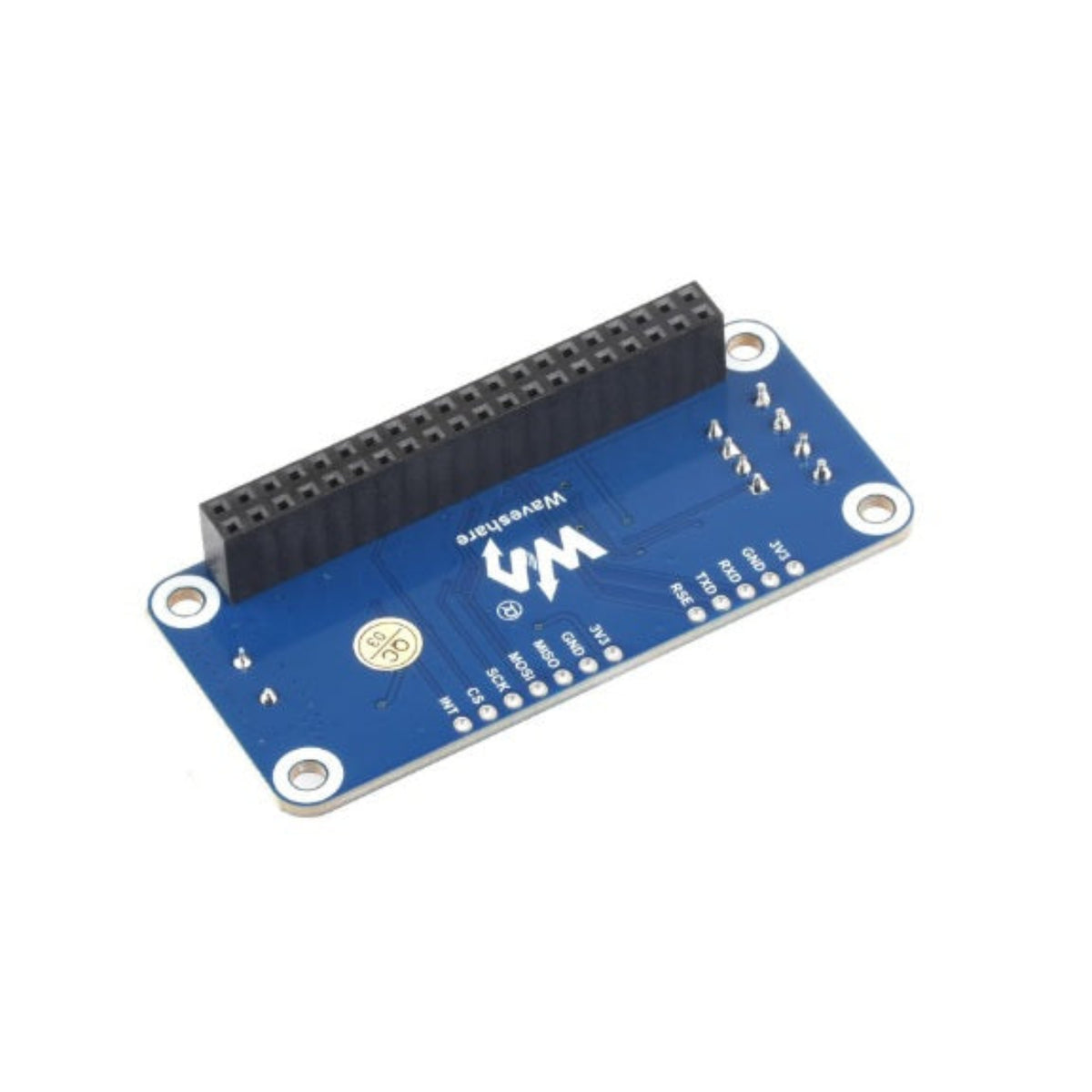


Waveshare RS485 CAN HAT for Raspberry Pi (MCP2515 / SP3485)
Waveshare RS485 CAN HAT for Raspberry Pi (MCP2515 / SP3485)
Couldn't load pickup availability
Short Product Description
Short Product Description
The Waveshare RS485 CAN HAT (Rev2.1) is a 3.3V communication expansion board designed for the Raspberry Pi 40-pin GPIO header. It adds isolated-free CAN bus communication via the onboard MCP2515 SPI controller and SIT65HVD230DR transceiver, alongside half-duplex RS485 connectivity via the SP3485 UART transceiver with automatic TX/RX switching. Featuring selectable 120Ω termination resistors, TVS surge protection for RS485, and a reserved control header, it suits industrial automation, Modbus/CAN bus prototyping, and embedded telemetry projects.
Key Features
Key Features
- Standard Raspberry Pi 40-Pin GPIO Header: Plugs directly onto Raspberry Pi series boards with pass-through male pins on top for easy probing or stacking.
- MCP2515 SPI-to-CAN Solution: Combines the MCP2515 CAN controller and SIT65HVD230DR transceiver to add CAN bus capability via the Raspberry Pi SPI bus.
- SP3485 UART-to-RS485 Half-Duplex: Supports automatic TX/RX direction control out of the box without software switching overhead, with optional manual RSE control via soldering.
- Independent 120Ω Terminal Resistor Switches: Two onboard DIP switches enable or disable 120Ω bus termination individually for CAN and RS485 endpoints.
- Onboard RS485 TVS Surge Protection: Integrated Transient Voltage Suppressor diodes suppress surge voltages, transient spikes, and ESD on the RS485 interface.
- Dual Fieldbus Connections: Provides both a 4-pin screw terminal block and a 4-pin header (H, L, B, A) for secure field wiring or quick Dupont bench connections.
- Reserved Control Header: Exposes SPI, UART, RSE, 3V3, and GND solder pads for interfacing with external MCU boards instead of a Raspberry Pi.
- Development Resources Included Online: Supported by Waveshare online documentation and sample code in wiringPi and Python.
Full Product Description
Full Product Description
Reliable CAN Bus and RS485 Expansion for Raspberry Pi
The Waveshare RS485 CAN HAT equips any 40-pin Raspberry Pi board with both CAN and RS485 industrial communication interfaces on a compact 65×30mm PCB. Because Raspberry Pi boards do not include native CAN or RS485 transceivers, this HAT bridges the Pi's SPI and UART buses directly to standard differential fieldbus wiring through a 4-pin green screw terminal block and a parallel 4-pin yellow pin header.
Dual-Protocol Architecture: MCP2515 CAN and SP3485 RS485
This Rev2.1 board handles CAN and RS485 on separate hardware buses so both protocols can operate simultaneously without pin conflicts. CAN communication runs over the SPI interface (MOSI, MISO, SCK, CS, and INT) using the Microchip MCP2515 controller paired with a SIT65HVD230DR transceiver. RS485 communication uses the Raspberry Pi UART pins (TXD and RXD) with an SP3485 half-duplex transceiver that provides automatic TX/RX direction control without extra programming.
Onboard Protection, 120Ω Termination, and Reserved Control Header
Built-in hardware safeguards and flexible wiring options simplify field deployment and bench testing. A 2-way DIP switch labeled 120R lets you enable or disable the onboard 120Ω terminal resistors independently for the CAN (H/L) and RS485 (A/B) lines. On the RS485 side, onboard Transient Voltage Suppressor (TVS) diodes help suppress surge voltages, transient spikes, and electrostatic discharge. An unpopulated row of through-hole pads (3V3, GND, RXD, TXD, RSE, MISO, MOSI, SCK, CS, INT) also allows wiring the module to non-Raspberry Pi microcontrollers or custom control boards.
Technician Tip
Before connecting fieldbus cables, verify that both SPI and UART interfaces are enabled in Raspberry Pi OS configuration (raspi-config) and confirm whether your bus topology requires the 120Ω termination resistors. For RS485, automatic TX/RX switching is active by default; only solder the jumper configuration for the RSE pin (GPIO4 / Pin 7) if your application specifically requires manual GPIO direction control. As this is a non-isolated 3.3V HAT, avoid connecting RS485 or CAN bus lines that carry high ground potential differences without external isolation, and remember that the Raspberry Pi board shown in setup photos is sold separately.
Technical Specifications
Technical Specifications
- Brand: Waveshare
- Model: RS485 CAN HAT (PCB Rev2.1)
- Operating Voltage: 3.3V (via Raspberry Pi 3V3 pin)
- CAN Controller: MCP2515 (via SPI interface)
- CAN Transceiver: SIT65HVD230DR
- RS485 Transceiver: SP3485 (via UART interface, half-duplex)
- RS485 TX/RX Control: Automatic control by default (manual control via Pin 7 / BCM 4
RSErequires soldering modification) - Bus Termination: Onboard 120Ω terminal resistors for CAN and RS485 (selectable via 2-way DIP switch)
- Protection: Onboard TVS (Transient Voltage Suppressor) for RS485 surge and ESD protection
- Host Interface: Standard Raspberry Pi 40-pin GPIO header + reserved control pads (
3V3,GND,RXD,TXD,RSE,MISO,MOSI,SCK,CS,INT) - Fieldbus Connectors: 4-pin screw terminal block & 4-pin yellow pin header (
H,L,B,A) - Board Dimensions: 65.00 × 30.00 mm
- Mounting Hole Spacing: 58.00 × 23.00 mm
- Mounting Hole Size: 3.00 mm
- Development Resources: Online manual with wiringPi and Python examples
Delivery Options
Delivery Options
- Local delivery within Hong Kong and in-store pickup.
- Free shipping for orders of HK$400 or above; HK$35 shipping fee for orders below HK$400.
- Shipped by SF Express, usually dispatched the same day for orders confirmed before 6:00 PM (Mon–Sat).
- Estimated delivery time: 1–3 business days after dispatch (Hong Kong).
- In-store pickup details (location and time) will be confirmed by email or phone message.
- Delivery times are estimates and may be affected by weather or unforeseen circumstances.
FAQ Section
FAQ Section
1. Which Raspberry Pi models are compatible with this Waveshare RS485 CAN HAT?This HAT is compatible with Raspberry Pi boards equipped with a standard 40-pin GPIO header, and its 65×30mm footprint matches the Raspberry Pi Zero form factor as well as larger models like Raspberry Pi 4B. It uses 3.3V power and logic from the 40-pin header, and SPI/UART pins (BCM 8, 9, 10, 11, 14, 15, 25, plus optional BCM 4) must be available on your setup.
2. How does the onboard RS485 automatic TX/RX control differ from manual RSE control?By default, the board handles RS485 transmit and receive direction switching automatically in hardware, so your UART code does not need to toggle a direction GPIO pin. If your project requires manual half-duplex timing control, the RSE line (Pin 7 / BCM 4, High for TX, Low for RX) is available after performing the required soldering modification shown in Waveshare's documentation.
3. When should I turn on the onboard 120Ω terminal resistor DIP switches?You should switch the 120R DIP switches to ON only when the Raspberry Pi sits at one of the physical ends of your CAN or RS485 bus. The two-position DIP switch controls CAN (1) and RS485 (2) independently, so you can leave an unused bus switched OFF or disable termination if your node sits in the middle of a daisy-chained network.
4. Can I pick up this HAT or match Raspberry Pi wiring accessories in Hong Kong?Yes, you can confirm compatibility and arrange local pickup at Sun Cheong Computer Co. Ltd. (新昌電腦有限公司) on Apliu Street, Sham Shui Po. Bringing your Raspberry Pi board or project wiring list to the shop helps ensure you get the right twisted-pair cabling, Dupont jumpers, or power adapters in one visit.
5. Can I use this RS485 CAN HAT with an Arduino or another 3.3V microcontroller instead of a Raspberry Pi?Yes, the unpopulated Reserved Control Header along the edge of the PCB breaks out all required SPI, UART, RSE, 3V3, and GND pins for connecting external control boards. However, because this board operates at 3.3V, you must use a 3.3V-compatible microcontroller or add a bidirectional logic level converter if interfacing with a 5V board.
Target Users / Applications
Target Users / Applications
- Industrial Automation & Modbus RTU Integrators: Polling RS485 sensors, meters, VFDs, or PLCs from a Raspberry Pi gateway.
- Automotive & Robotics CAN Bus Developers: Prototyping CAN bus monitoring, data logging, and motor controller communication using SocketCAN or Python.
- Smart Building & Solar Telemetry Engineers: Building compact Raspberry Pi Zero or Pi 4 edge nodes for inverter, battery BMS, or HVAC RS485/CAN telemetry.
- University Engineering & STEM Robotics Teams: Teaching differential industrial serial protocols (MCP2515 + SP3485) with ready-made wiringPi and Python examples.