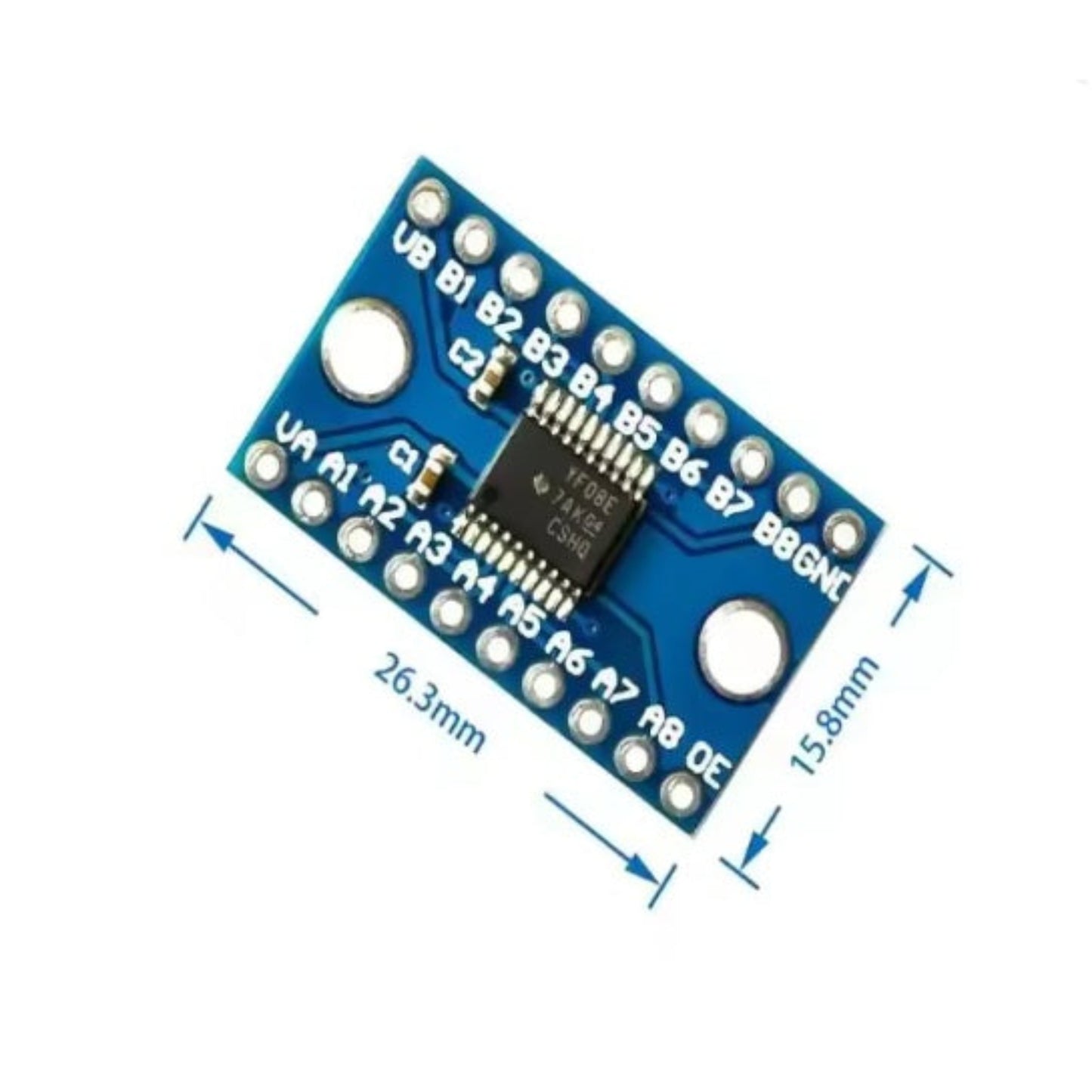


TXS0108E 8-Channel Bi-Directional Logic Level Converter Module
TXS0108E 8-Channel Bi-Directional Logic Level Converter Module
Couldn't load pickup availability
Short Product Description
Short Product Description
Stop worrying about fried sensors or mismatched voltages. The TXS0108E 8-Channel Bi-Directional Logic Level Converter is the ultimate bridge for your high-speed digital projects. Whether you are connecting a 3.3V Raspberry Pi to a 5V relay or interfacing SD cards with Arduino, this full-duplex module ensures seamless, high-speed communication across 8 independent channels. No direction control pin is required—just plug and play for reliable, bi-directional signal translation.
Key Features
Key Features
- 8-Channel Bi-Directional Translation: Convert up to 8 signals simultaneously without manual direction control.
- High-Speed Full-Duplex: Perfect for fast data protocols like SPI and high-speed I2C bus communication.
- Wide Voltage Range Support: Seamlessly bridges 1.2V to 5.5V logic environments.
- Auto-Sensing Technology: Simplifies circuit design by eliminating the need for a direction (DIR) control pin.
- Breadboard Friendly: Comes with pin headers, making it easy to integrate into prototypes or STEM educational kits.
Full Product Description
Full Product Description
High-Speed Performance for Modern Electronics
In the world of DIY electronics and industrial prototyping, voltage mismatch is a common hurdle. Most modern sensors and SD cards operate at 3.3V, while many traditional microcontrollers still use 5V. The TXS0108E module provides a robust, 8-bit solution to this problem. Unlike cheaper alternatives, this module supports high-speed full-duplex communication, making it ideal for timing-sensitive protocols like SPI, I2C, and UART.
Why Choose the TXS0108E?
The core strength of the TXS0108E lies in its auto-direction sensing capability. You don't need to set a direction pin to tell the module which way the data is flowing; it detects it automatically. This reduces wiring complexity and frees up valuable I/O ports on your microcontroller.
Versatile Voltage Compatibility
This module is designed for flexibility. Port A handles lower voltages (1.2V to 3.6V), while Port B manages higher voltages (1.65V to 5.5V). This wide range makes it compatible with almost any combination of logic levels found in consumer and industrial electronics today.
Technical Specifications
Technical Specifications
- Chipset: TXS0108E
- Channels: 8-bit (full duplex)
- Port A Voltage (VCCA): 1.2 V – 3.6 V
- Port B Voltage (VCCB): 1.65 V – 5.5 V
- Requirement: VCCA≤VCCBVCCA≤VCCB
- Dimensions: 26.3 mm × 15.8 mm
- Mounting: 2× side mounting holes
Delivery Options
Delivery Options
- Local delivery within Hong Kong and in-store pickup.
- Free shipping for orders of HK$400 or above; HK$35 shipping fee for orders below HK$400.
- Shipped by SF Express, usually dispatched the same day for orders confirmed before 6:00 PM (Mon–Sat).
- Estimated delivery time: 1–3 business days after dispatch (Hong Kong).
- In-store pickup details (location and time) will be confirmed by email or phone message.
- Delivery times are estimates and may be affected by weather or unforeseen circumstances.
FAQ Section
FAQ Section
Q: Does this module require a direction control pin?
A: No. The TXS0108E features automatic direction sensing, meaning it detects the data flow direction without an external DIR pin.
Q: Can I use this for I2C communication?
A: Yes, it is excellent for I2C. However, ensure your pull-up resistors are correctly configured if you are working with long cable runs or high-speed modes.
Q: What should I do with the OE (Output Enable) pin?
A: The OE pin is "Active High." For normal operation, it should be pulled high. It is recommended to connect it to the lower voltage ($VCCA$) side to ensure the pins stay in a high-impedance state during power-up.
Target Users / Applications
Target Users / Applications
- STEM Educators & Students: Essential for learning microcontroller interfacing.
- IoT Developers: Connecting 3.3V sensors (like BME280) to 5V MCUs.
- System Integrators: Interfacing industrial CCTV controllers with consumer electronics.
- Arduino & Raspberry Pi Hobbyists: Bridging different logic levels for SD card modules or LCD screens.