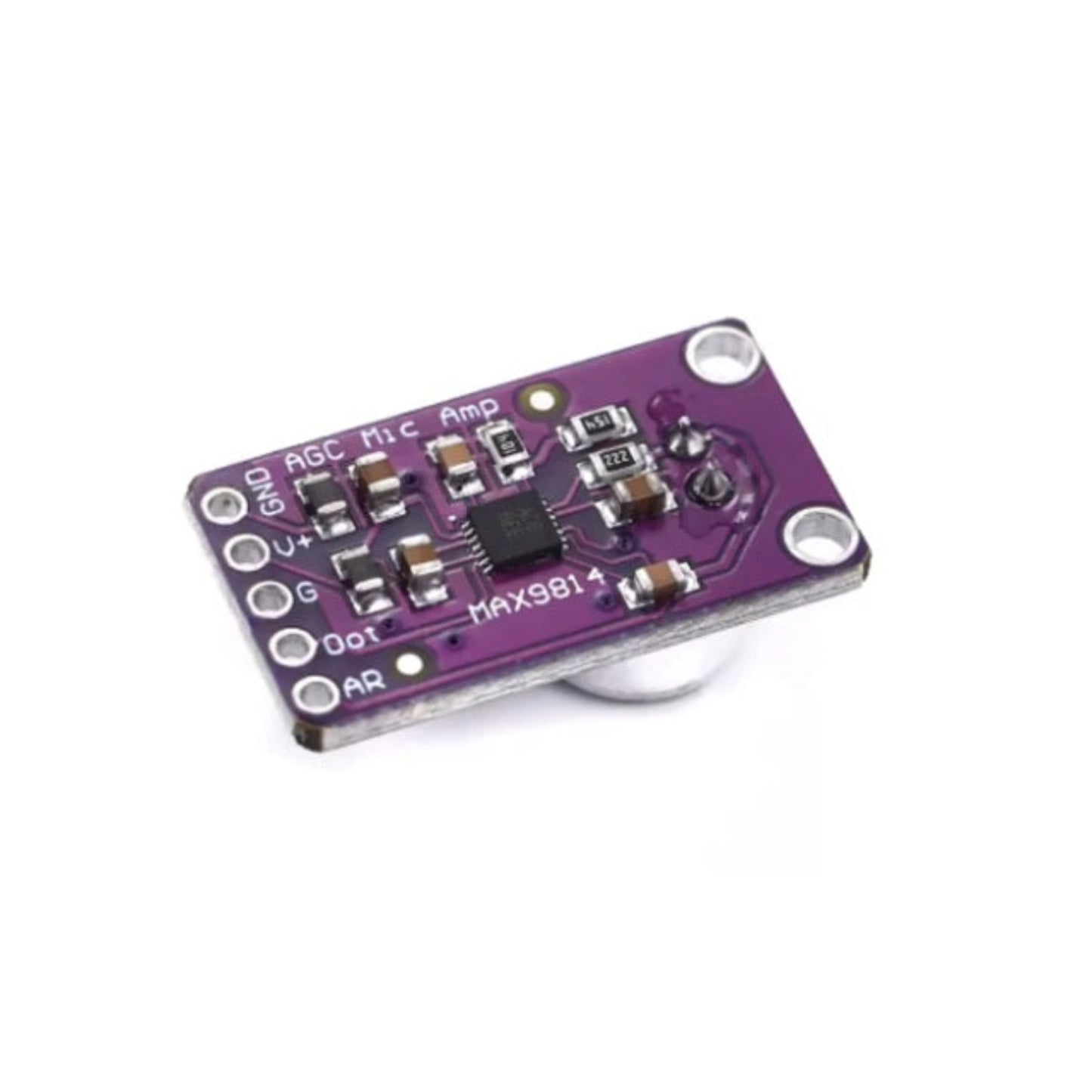


MAX9814 Electret Microphone Amplifier Module | AGC Auto Gain Control
MAX9814 Electret Microphone Amplifier Module | AGC Auto Gain Control
Couldn't load pickup availability
Short Product Description
Short Product Description
Tired of distorted audio and clipping in your DIY sound projects? TheMAX9814 Electret Microphone Amplifier Modulesolves this with built-inAutomatic Gain Control (AGC). Operating on 2.7V-5.5V, this module automatically boosts quiet sounds and dampens loud noises, delivering crystal-clear analog audio to your Arduino or Raspberry Pi. Featuring three selectable gain modes (40dB, 50dB, 60dB) and ultra-low 0.04% THD, it is perfect for voice recognition, audio-reactive LEDs, and custom intercoms. Need help wiring your audio circuit?Sun Cheong Computer Co. Ltd.has over 20 years of STEM expertise. Visit our Sham Shui Po physical store for instant pickup and expert technical advice!
Key Features
Key Features
- Automatic Gain Control (AGC): Dynamically adjusts audio levels to prevent clipping from loud noises and boost quiet whispers.
- Three Selectable Gain Settings: Easily configure the max gain to 40dB, 50dB, or 60dB by wiring a single pin.
- Ultra-Low Distortion: Features a low THD of 0.04% (typ) for high-fidelity, crystal-clear audio recording.
- Wide Voltage Compatibility: Operates smoothly between 2.7V and 5.5V, making it perfect for both 3.3V (Raspberry Pi/ESP32) and 5V (Arduino) systems.
- Programmable Attack & Release: Advanced users can adjust the attack/release ratio via the AR pin for custom audio compression.
- Low-Power Shutdown Mode: Draws only 3mA during operation and supports a shutdown mode to conserve battery life in portable IoT devices.
Full Product Description
Full Product Description
Stop Audio Clipping with Automatic Gain Control (AGC)
Standard microphone modules often struggle with dynamic audio environments—whispers are too quiet to detect, while loud claps cause severe distortion and clipping. The MAX9814 Microphone Amplifier eliminates this problem using advanced Automatic Gain Control (AGC). This built-in hardware feature dynamically adjusts the amplifier's gain in real-time. It automatically turns down the volume when sounds get too loud and boosts the sensitivity when sounds are quiet, ensuring your microcontroller receives a smooth, consistent analog waveform.
Selectable Gain for Any Environment
Not every project requires the same level of sensitivity. The MAX9814 module features a dedicated "Gain" pin that allows you to easily configure the maximum amplification level. You can set it to 40dB, 50dB, or 60dB depending on your application. Whether you are building a sensitive sleep-talking recorder or a loud karaoke entertainment system, this module adapts perfectly to your acoustic environment.
Ultra-Low Noise & High-Fidelity Output
Designed for high-quality audio applications, this module boasts an incredibly low Total Harmonic Distortion (THD) of just 0.04%. It includes an internal low-noise 2V microphone bias, ensuring that the analog signal sent to your Arduino's ADC (Analog-to-Digital Converter) is clean and free from static interference. The output is a 2Vpp max signal with a 1.25V DC offset, making it incredibly easy to read with standard 3.3V or 5V microcontrollers.
💡 Pro Tip from Our Technicians
"Wiring the Gain pin on the MAX9814 is incredibly simple but often overlooked by beginners! As printed on the back of the PCB: if you leave the Gain pin floating (unconnected), the module defaults to a highly sensitive 60dB. If you connect the Gain pin to GND, it drops to 50dB. Connecting it to VDD sets it to 40dB."
Technical Specifications
Technical Specifications
| Specification | Details |
|---|---|
| Amplifier IC | Maxim MAX9814 |
| Supply Voltage (VDD) | 2.7V - 5.5V DC |
| Operating Current | 3mA |
| Frequency Response | 20Hz - 20KHz |
| Total Harmonic Distortion (THD) | 0.04% (Typical) |
| Selectable Gain | 40dB (VDD), 50dB (GND), 60dB (Floating) |
| Output Signal | Analog (2Vpp Max, 1.25V DC Offset) |
| Microphone Bias | Internal Low-Noise 2V |
| Included Accessories | 1x MAX9814 Module, 1x 5-Pin Header |
Delivery Options
Delivery Options
- Local delivery within Hong Kong and in-store pickup.
- Free shipping for orders of HK$400 or above; HK$35 shipping fee for orders below HK$400.
- Shipped by SF Express, usually dispatched the same day for orders confirmed before 6:00 PM (Mon–Sat).
- Estimated delivery time: 1–3 business days after dispatch (Hong Kong).
- In-store pickup details (location and time) will be confirmed by email or phone message.
- Delivery times are estimates and may be affected by weather or unforeseen circumstances.
FAQ Section
FAQ Section
- What is the difference between the MAX9814 and the MAX4466 microphone module?The biggest difference is the Automatic Gain Control (AGC). The MAX4466 has a fixed gain (adjusted manually via a tiny potentiometer), meaning loud noises will cause distortion. The MAX9814 automatically adjusts its gain on the fly, making it far superior for environments with unpredictable volume levels, like voice recognition or party lighting.
- Can I connect this module directly to a speaker?No. The MAX9814 is a pre-amplifier designed to output a low-voltage analog signal to a microcontroller (like an Arduino's A0 pin) or an audio line-in. To drive a physical speaker, you will need to connect the output of this module to a dedicated power amplifier (like a PAM8403 or LM386).
- How do I connect the AR (Attack/Release) pin?For most standard Arduino projects, you can leave the AR pin floating (unconnected). This sets the default Attack/Release ratio to 1:4000. Advanced users can connect it to VDD for a 1:2000 ratio, or to GND for a 1:500 ratio to change how fast the AGC reacts to sudden loud noises
Target Users / Applications
Target Users / Applications
- STEM Educators & Students: Building audio-reactive LED matrix displays (VU meters) using Arduino and FastLED libraries.
- Smart Home DIYers: Creating custom voice-recognition triggers or sound-activated security alarms using ESP32 boards.
- Cosplay & Prop Makers: Integrating sound-responsive lighting into helmets or weapons without worrying about loud convention noise causing sensor glitches.