

Arduino UNO Q (ABX00173) Single-Board Computer | 4GB RAM 32GB eMMC
Arduino UNO Q (ABX00173) Single-Board Computer | 4GB RAM 32GB eMMC
Couldn't load pickup availability
Short Product Description
Short Product Description
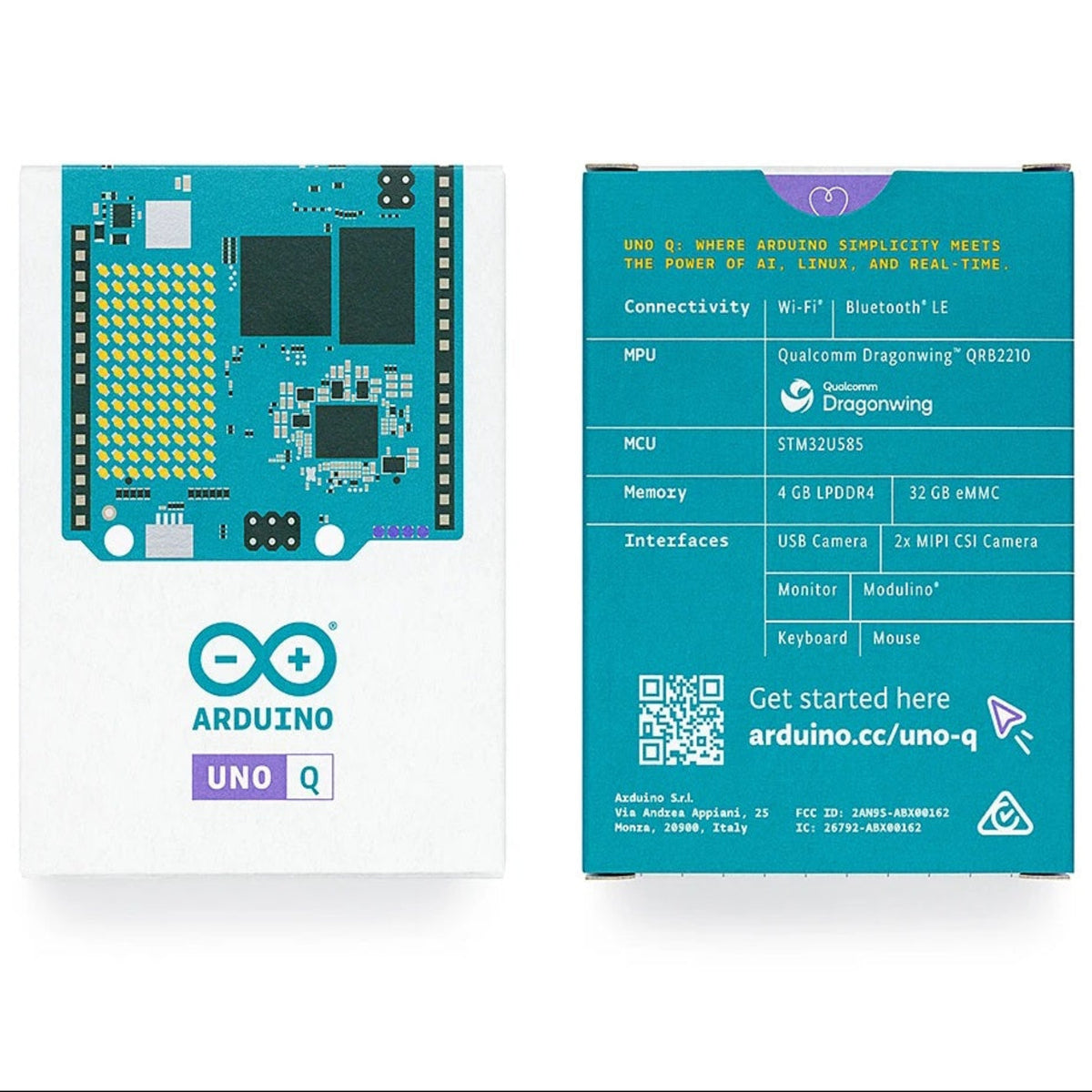
The Arduino UNO Q (ABX00173) is an advanced single-board computer that bridges the gap between high-level OS computing and real-time hardware control. Combining a quad-core Qualcomm QRB2210 Linux processor with an STM32U585 microcontroller, it features 4GB LPDDR4X RAM, 32GB eMMC storage, and an integrated Adreno 702 GPU. Equipped with Wi-Fi 5, Bluetooth 5.1, and a Qwiic connector, this board is the ultimate platform for developing Edge AI, machine vision, and sophisticated robotics projects.
Key Features
Key Features
- Dual-Core Power: Combines a Qualcomm QRB2210 (Linux) and an STM32U585 (Zephyr OS) for perfectly balanced computing and control.
- High Capacity Memory: Equipped with 4GB LPDDR4X RAM and 32GB eMMC storage for smooth OS operation and AI model execution.
- Wireless Connectivity: Built-in Wi-Fi 5 and Bluetooth 5.1 allow for seamless IoT integration and remote project monitoring.
- Advanced I/O: Features a USB-C port with DisplayPort Alt-Mode, MIPI camera/display lanes, and a plug-and-play Qwiic connector.
- Visual Feedback: Includes an onboard 8x13 LED matrix (104 pixels) for instant status indicators and custom animations.
- Arduino Ecosystem: Fully compatible with classic 3.3V UNO shields and the unified Arduino App Lab development environment.
Full Product Description
Full Product Description
Dual-Processor Architecture for AI and Real-Time Control
The UNO Q integrates a Linux-based application processor and a real-time microcontroller on a single board. The Qualcomm Dragonwing QRB2210 handles heavy workloads like Debian Linux, AI models, and 3D graphics, while the STMicroelectronics STM32U585 MCU manages precise, time-critical I/O tasks. They communicate seamlessly via Arduino's RPC Bridge, allowing your high-level Linux applications to interact instantly with low-level sensors and motors without latency.
Hardware Acceleration for Machine Vision
An integrated Adreno 702 GPU provides dedicated hardware acceleration for 3D graphics and video encoding/decoding. Capable of processing 1080p video and supporting OpenGL, Vulkan, and OpenCL, it offloads compute-intensive tasks from the CPU. The board also features MIPI-CSI and MIPI-DSI interfaces, making it incredibly powerful for developing smart cameras, facial recognition systems, and interactive displays.
Technician Tip
Always use a high-quality 5V/3A USB-C power supply to ensure stable operation during heavy AI or GPU workloads. Because the board handles Wi-Fi bursts and Linux processing simultaneously, standard low-current chargers may cause sudden resets. If you are building an autonomous robotics project, you can bypass USB-C and power the board directly via the 7-24V VIN pin. Visit Sun Cheong Computer Co. Ltd. in Sham Shui Po to find compatible high-output power supplies and Qwiic sensor modules for your build.
Technical Specifications
Technical Specifications
- Microprocessor (MPU): Qualcomm Dragonwing QRB2210 (Quad-core Arm Cortex-A53 @ 2.0 GHz)
- Microcontroller (MCU): STMicroelectronics STM32U585 (Arm Cortex-M33 up to 160 MHz)
- Memory: 4GB LPDDR4X
- Storage: 32GB eMMC
- GPU: Adreno 702 @ 845 MHz (Supports OpenGL, Vulkan, OpenCL)
- Wireless: Wi-Fi 5 (802.11a/b/g/n/ac) + Bluetooth 5.1
- Power Input: USB-C (5V/3A) or VIN pin (7-24V DC)
- Logic Voltage: 3.3V (Note: A0 and A1 analog pins are NOT 5V tolerant)
Delivery Options
Delivery Options
- Local delivery within Hong Kong and in-store pickup.
- Free shipping for orders of HK$400 or above; HK$35 shipping fee for orders below HK$400.
- Shipped by SF Express, usually dispatched the same day for orders confirmed before 6:00 PM (Mon–Sat).
- Estimated delivery time: 1–3 business days after dispatch (Hong Kong).
- In-store pickup details (location and time) will be confirmed by email or phone message.
- Delivery times are estimates and may be affected by weather or unforeseen circumstances.
FAQ Section
FAQ Section
Can I use my existing Arduino UNO shields with the UNO Q?
Yes, the board features standard JDIGITAL and JANALOG headers that are compatible with most 3.3V logic UNO shields. However, please note that the analog pins A0 and A1 are strictly 3.3V and are not 5V-tolerant, so external conditioning is required for higher voltages.
What is the difference between the UNO Q and a standard Raspberry Pi?
The UNO Q uniquely combines a Linux application processor with a dedicated real-time STM32 microcontroller on one board. This allows you to run complex AI models on Linux while maintaining microsecond-precise hardware control over motors and sensors, eliminating the need for an external MCU.
How do I power the Arduino UNO Q for robotics projects?
You can power the board using a 5V/3A USB-C adapter, or supply 7-24V DC directly to the VIN pin. The wide 7-24V input range makes it ideal for battery-powered robots, drones, and autonomous vehicles without needing a separate step-down converter.
Can I connect an external monitor directly to the UNO Q?
Yes, the USB-C port supports DisplayPort Alt-Mode. You can output up to 1080p video directly to a compatible monitor or through a USB-C display hub, making it easy to set up a desktop environment or interactive kiosk.
Is the Arduino UNO Q ABX00173 available for immediate pickup in Hong Kong?
Yes, the high-capacity 4GB RAM / 32GB eMMC variant (ABX00173) is stocked at our Sham Shui Po physical store. You can order online for delivery or drop by during business hours for immediate purchase and project integration.
Target Users / Applications
Target Users / Applications
- Edge AI Developers: Deploying object classification and machine vision models locally using the Adreno GPU.
- Robotics Engineers: Building autonomous delivery robots that require both Linux-based navigation and real-time motor control.
- Smart Home Prototypers: Creating voice-controlled climate hubs or facial recognition doorbells.
- STEM Educators: Teaching advanced computer science concepts, bridging the gap between Python (Linux) and C++ (Arduino).