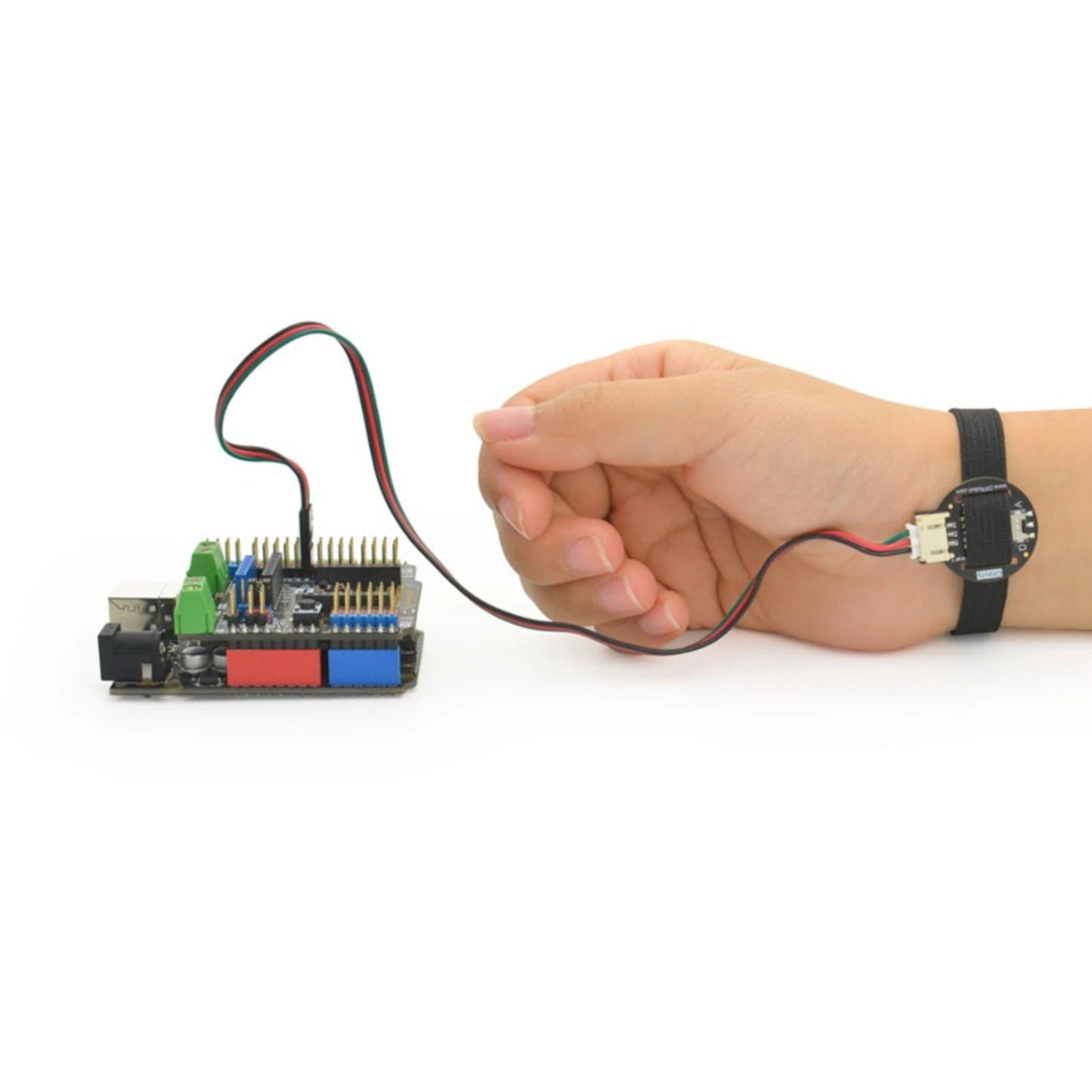


DFRobot Gravity PPG Heart Rate Sensor for Arduino & Pi | IoT Ready
DFRobot Gravity PPG Heart Rate Sensor for Arduino & Pi | IoT Ready
Couldn't load pickup availability
Short Product Description
Short Product Description
Build your own IoT biometric tracker with theDFRobot Gravity PPG Heart Rate Sensor. Designed for Arduino, Raspberry Pi, and 3.3V/5V microcontrollers, this thumb-sized module uses optical PPG technology to measure blood volume changes and detect your pulse. It features a plug-and-play Gravity interface (PH2.0-3P) and outputs both analog and digital signals. Perfect for STEM education and DIY wearables! Need coding or wiring help?Sun Cheong Computer Co. Ltd.has over 20 years of electronic component expertise. Visit our Sham Shui Po physical store for instant pickup and expert technical advice for your DIY projects!
Key Features
Key Features
- Optical PPG Detection: Uses advanced light-based technology to detect blood volume changes and accurately measure your pulse rate.
- Analog & Digital Output: Highly versatile module that provides both 0-Vin (Analog) and 0/Vin (Digital) signal outputs for different programming needs.
- Wide Voltage Compatibility: Operates smoothly between 3.3V and 6V, making it perfectly compatible with Arduino, Raspberry Pi, and ESP32 boards.
- Plug & Play Gravity Interface: Features a PH2.0-3P connector for instant, solder-free connection to Gravity IO expansion shields.
- Wearable Accessories Included: Comes complete with a comfortable wrist belt and a high-quality sensor cable, ready to wear out of the box.
- IoT Application Ready: Easily send your real-time pulse data to cloud platforms like the Blynk App for remote monitoring.
Full Product Description
Full Product Description
Build IoT Health Trackers with Ease
Diving into biometric data collection has never been more accessible. The DFRobot Gravity Heart Rate Monitor Sensor is a micro-sized optical sensor designed to easily integrate with your favorite microcontrollers. Whether you are building a sleep monitor, an interactive art installation that responds to your heartbeat, or an IoT dashboard using the Blynk application, this sensor provides the raw pulse data you need to bring your code to life.
Optical PPG Technology Explained
This sensor utilizes Photoplethysmography (PPG), a simple yet highly effective optical technique. By shining a light into the skin and measuring the amount of light absorbed or reflected by the microvascular bed of tissues, it detects changes in blood volume. This allows the sensor to accurately map out the pulsatile component of your cardiac cycle. You can easily strap it to your finger, wrist, or earlobe using the included mounting holes and wrist belt.
Plug-and-Play Gravity Interface
Say goodbye to messy breadboards and confusing pinouts. This module features DFRobot's standardized Gravity Interface (PH2.0-3P). It is completely plug-and-play when used with a Gravity IO Sensor Shield. Operating on a wide 3.3V to 6V input range, it is natively compatible with 5V Arduino boards as well as 3.3V systems like the Raspberry Pi, Intel Edison, Joule, and Curie.
💡 Pro Tip from Our Technicians
"When working with this PPG sensor, stability is everything! This sensor is designed to work ONLY when the user is completely still. If you try to use it while walking or exercising, the optical readings will be highly inaccurate due to motion artifacts. Furthermore, please remember this is a DIY educational module, NOT a professional medical device, and should never be used for medical diagnosis. If you need help writing the Arduino code to filter out noise or sending the data to an IoT app, drop by our Sham Shui Po store! Our team at Sun Cheong Computer Co. Ltd. loves helping makers troubleshoot their STEM projects."
Technical Specifications
Technical Specifications
| Specification | Details |
|---|---|
| Sensor Type | Optical PPG (Photoplethysmography) Pulse Sensor |
| Input Voltage (Vin) | 3.3V - 6V DC (5V Recommended) |
| Output Voltage | 0 - Vin (Analog) / 0 or Vin (Digital) |
| Operating Current | < 10mA (Ultra-low power) |
| Interface Type | Gravity PH2.0-3P |
| Dimensions | 28 mm x 24 mm (1.102" x 0.945") |
| Compatibility | Arduino, Raspberry Pi, Intel Edison, Joule, Curie |
| Package Contents | 1x Sensor, 1x Wrist Belt, 1x PH2.0-3P Cable |
Delivery Options
Delivery Options
- Local delivery within Hong Kong and in-store pickup.
- Free shipping for orders of HK$400 or above; HK$35 shipping fee for orders below HK$400.
- Shipped by SF Express, usually dispatched the same day for orders confirmed before 6:00 PM (Mon–Sat).
- Estimated delivery time: 1–3 business days after dispatch (Hong Kong).
- In-store pickup details (location and time) will be confirmed by email or phone message.
- Delivery times are estimates and may be affected by weather or unforeseen circumstances.
FAQ Section
FAQ Section
- Can I use this sensor for sports tracking or medical diagnosis?No. This product is strictly an educational DIY sensor. It is NOT a professional medical device and cannot be used to diagnose or treat medical conditions. Additionally, it only provides accurate readings when the user is completely still; motion will disrupt the optical PPG readings.
- How do I connect this heart rate sensor to a Raspberry Pi?The sensor supports a 3.3V input, making it electrically compatible with the Raspberry Pi. However, because the Raspberry Pi lacks built-in Analog-to-Digital Converters (ADC), you will need to use an external ADC module (like the ADS1115) to read the analog pulse signals accurately.
- What is included in the DFRobot heart rate monitor kit?The kit comes ready to use. It includes one thumb-sized PPG Heart Rate Monitor Sensor, one adjustable black wrist belt for securing the sensor to your skin, and one Gravity PH2.0-3P connection cable.
Target Users / Applications
Target Users / Applications
- STEM Students & Educators: Learning how to process analog signals, filter noise, and build basic biometric data loggers.
- IoT Hobbyists: Creating remote health monitoring dashboards using ESP32 boards and the Blynk IoT application.
- Interactive Artists: Designing LED light displays or kinetic sculptures that pulse in sync with a user's heartbeat.