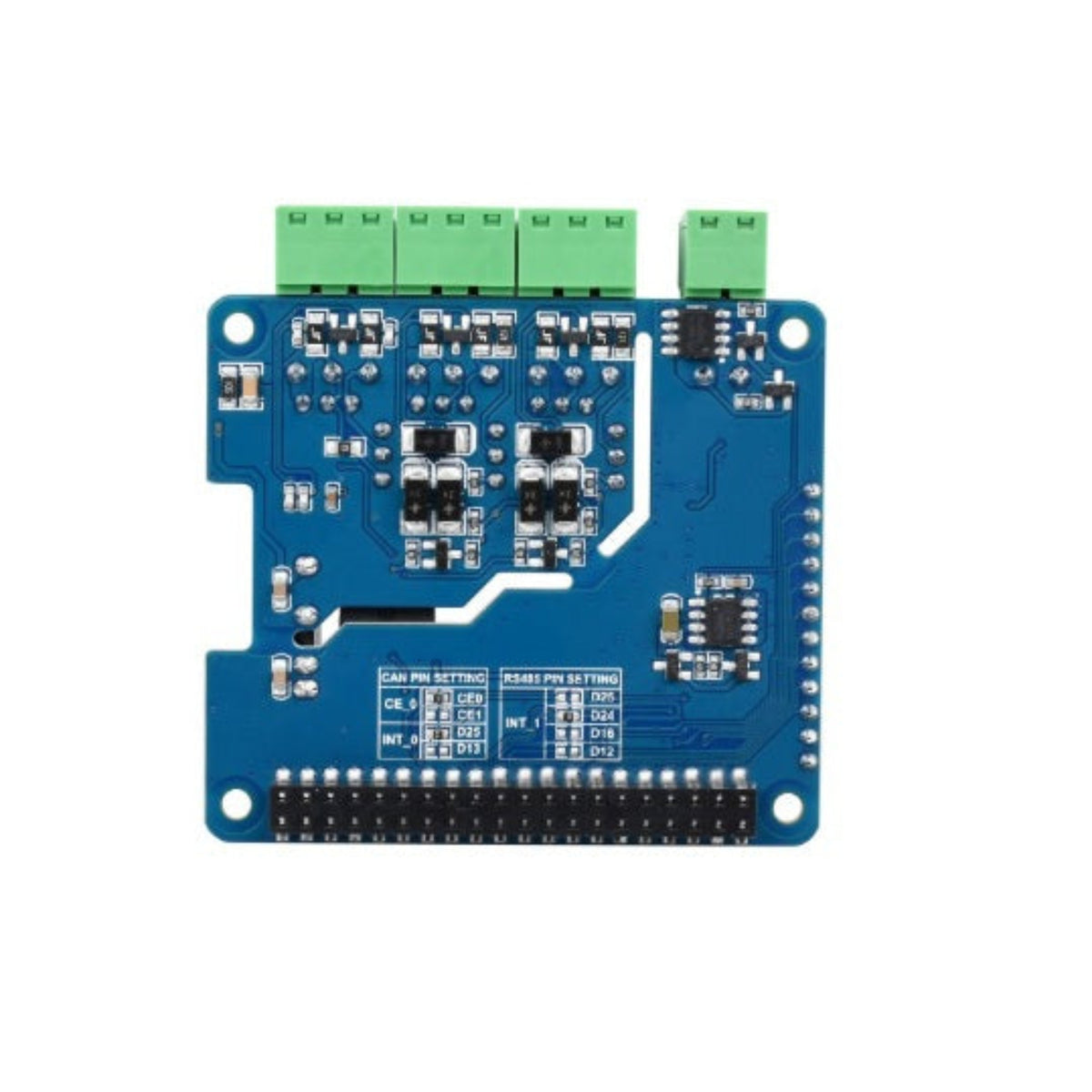


Waveshare Isolated RS485 CAN HAT (B) for Raspberry Pi (2x RS485 CAN)
Waveshare Isolated RS485 CAN HAT (B) for Raspberry Pi (2x RS485 CAN)
Couldn't load pickup availability
Short Product Description
Short Product Description
The Waveshare Isolated RS485 CAN HAT (B) is an industrial-grade expansion board that adds 2-channel isolated RS485 and 1-channel isolated CAN bus communication to any 40-pin Raspberry Pi via SPI. Equipped with an onboard B0505LS-1W power isolator, π163M31 digital isolator, TVS surge protection, resettable fuse, and a DC 8–28V power terminal capable of powering both the HAT and Raspberry Pi, it is designed for noisy industrial environments, Modbus RTU gateways, and multi-bus automation projects.
Key Features
Key Features
- 2-Ch RS485 + 1-Ch CAN via SPI: Expands two RS485 channels (SC16IS752 + SP3485) and one CAN channel (MCP2515 + SIT65HVD230DR/SN65HVD23D) without occupying the Raspberry Pi's primary UART.
- Unibody Power & Digital Isolation: Integrates a B0505LS-1W power isolator and π163M31 digital isolator to isolate fieldbus noise and prevent ground loops.
- DC 8–28V Wide-Range Power Terminal: Accepts industrial 12V/24V power rails to power both the HAT and the connected Raspberry Pi simultaneously, or runs from the Raspberry Pi 5V rail.
- Multi-Layer Circuit Protection: Combines TVS surge/ESD suppression with a resettable fuse and protection diodes for over-current and over-voltage protection.
- Configurable 120Ω Termination Jumpers: Individual jumper caps on RS485_0, RS485_1, and CAN_0 come set to 120Ω by default and switch easily to NC when termination is not needed.
- SPI Breakout & Remappable Control Pins: Includes a 12-pin SPI header for STM32/Arduino host boards plus rear PCB solder pads to reassign CE_0, INT_0, and INT_1 pins.
- Dual Wiring Options per Bus: Provides both 3.81mm-pitch green screw terminals (A, B, G and H, L, G) and parallel 3-pin yellow headers for field or bench connections.
Full Product Description
Full Product Description
Isolated Multi-Channel RS485 and CAN Expansion for Raspberry Pi
The Waveshare Isolated RS485 CAN HAT (B) equips Raspberry Pi boards with two independent RS485 ports and one CAN bus port while keeping the Raspberry Pi's native UART pins free. Because all three communication channels connect through the Raspberry Pi SPI0 and SPI1 buses, builders can run simultaneous 2-channel RS485 (300–921600 bps) and CAN (up to 1Mbps) communication on a single 65×56.5mm board.
Chipset Design: MCP2515 CAN and SC16IS752 + SP3485 Dual RS485
Dedicated interface ICs handle protocol conversion across two separate SPI channels. The CAN channel (CAN_0) uses the Microchip MCP2515 controller paired with a SIT65HVD230DR/SN65HVD23D transceiver over SPI0. The dual RS485 channels (RS485_0 and RS485_1) use an SC16IS752 SPI-to-dual-UART expansion chip paired with two SP3485 half-duplex transceivers over SPI1. An extra 12-pin yellow SPI control header breaks out both SPI buses so the board can also interface with external microcontrollers such as STM32 or Arduino.
Unibody Power/Signal Isolation, TVS Protection, and 8–28V Wide Input
Built-in electrical isolation and multi-stage circuit protection shield the host board from ground loops and fieldbus transients. An onboard B0505LS-1W unibody power isolation module supplies isolated power to the bus side without requiring a separate isolated supply, while a π163M31 digital isolator isolates logic signals across the PCB isolation slot. Onboard TVS (Transient Voltage Suppressor) diodes, a resettable fuse, and protection diodes guard against surge voltages, over-current, over-voltage, and ESD. You can power the HAT via the Raspberry Pi 5V GPIO header or feed DC 8–28V into the external screw terminal to power both the HAT and the Raspberry Pi together.
Technician Tip
Enable both SPI_0 and SPI_1 in Raspberry Pi OS before testing, and verify whether your bus topology needs the default 120Ω termination jumper caps fitted on RS485_0, RS485_1, and CAN_0 (move jumpers to NC for mid-bus nodes). If CE_0 (BCM 8), INT_0 (BCM 25), or INT_1 (BCM 24) conflict with another HAT, the underside of the PCB provides solder-pad selectors to remap CE_0 (CE0/CE1), INT_0 (D25/D13), and INT_1 (D25/D24/D16/D12). When feeding DC 8–28V into the external power terminal, check polarity carefully and avoid double-powering the Raspberry Pi from an incompatible external USB-C supply simultaneously; note that the Raspberry Pi board shown in demonstration photos is not included.
Technical Specifications
Technical Specifications
- Brand: Waveshare
- Model: Isolated RS485 CAN HAT (B)
- Expanded Interfaces: 2-Ch RS485 + 1-Ch CAN
- Host Communication Interface: SPI (SPI_0 for CAN, SPI_1 for dual RS485)
- Operating Voltage: 3.3V
- Power Supply Options: External DC 8–28V screw terminal (powers HAT and Raspberry Pi) OR Raspberry Pi 5V GPIO pins
- CAN Controller: MCP2515
- CAN Transceiver: SIT65HVD230DR / SN65HVD23D
- CAN Baud Rate: ≤ 1 Mbps
- UART Expansion Chip: SC16IS752
- RS485 Transceiver: SP3485 (×2)
- RS485 Baud Rate: 300 – 921600 bps
- Isolation Components: B0505LS-1W unibody power supply isolation + π163M31 digital isolator
- Circuit Protection: TVS (Transient Voltage Suppressor), resettable fuse, protection diodes
- Bus Termination: Onboard 120Ω terminal resistor jumpers for RS485_0, RS485_1, and CAN_0 (120Ω by default)
- Connectors: Standard Raspberry Pi 40-pin GPIO header, 12-pin SPI control header, 2-pin DC 8–28V screw terminal, three 3-pin bus screw terminals & pin headers
- Board Dimensions: 65.00 × 56.50 mm (Mounting hole spacing: 58.00 × 49.00 mm; hole size: 3.00 mm)
Delivery Options
Delivery Options
- Local delivery within Hong Kong and in-store pickup.
- Free shipping for orders of HK$400 or above; HK$35 shipping fee for orders below HK$400.
- Shipped by SF Express, usually dispatched the same day for orders confirmed before 6:00 PM (Mon–Sat).
- Estimated delivery time: 1–3 business days after dispatch (Hong Kong).
- In-store pickup details (location and time) will be confirmed by email or phone message.
- Delivery times are estimates and may be affected by weather or unforeseen circumstances.
FAQ Section
FAQ Section
1. What is the difference between the Waveshare RS485 CAN HAT (B) and the standard RS485 CAN HAT?The Isolated RS485 CAN HAT (B) upgrades to 2-channel RS485 plus 1-channel CAN over SPI, adds unibody B0505LS-1W power isolation and π163M31 digital isolation, includes a resettable fuse and protection diodes, and supports an external DC 8–28V power input. In contrast, the standard non-isolated RS485 CAN HAT offers 1-channel RS485 via UART and 1-channel CAN via SPI without galvanic isolation or 8–28V power input.
2. Can the DC 8–28V external power terminal power my Raspberry Pi at the same time?Yes, the onboard power conversion circuit accepts DC 8–28V at the 2-pin external terminal and supplies regulated 5V power to both the HAT and the attached Raspberry Pi through the 40-pin GPIO header. You can also choose to power the HAT from the Raspberry Pi instead if an external industrial DC supply is not used.
3. How do I enable both RS485 channels and the CAN channel if they all use SPI?The board separates CAN onto SPI_0 (using MCP2515) and both RS485 channels onto SPI_1 (using the dual-UART SC16IS752 bridge), so you need both SPI0 and SPI1 enabled on your Raspberry Pi. Because RS485 does not occupy the Raspberry Pi hardware UART pins (GPIO 14/15), your native serial port remains free for other peripherals.
4. Where can I buy this isolated HAT and matching 12V/24V industrial power supplies in Hong Kong?You can order online or arrange in-store pickup at Sun Cheong Computer Co. Ltd. (新昌電腦有限公司) on Apliu Street, Sham Shui Po, Kowloon. Our shop also carries compatible DC 12V/24V power adapters, twisted-pair wiring accessories, and Raspberry Pi boards so you can source your setup together.
5. What happens if CE_0, INT_0, or INT_1 pins conflict with another Raspberry Pi HAT in my stack?You can change the chip-select and interrupt pin assignments using the solder-pad jumpers on the underside of the PCB. Specifically, the rear markings allow remapping CE_0 between CE0 and CE1, INT_0 between D25 and D13, and INT_1 across D25, D24, D16, or D12.
Target Users / Applications
Target Users / Applications
- Industrial PLC & Inverter Control Cabinets: Running Raspberry Pi gateways powered directly from 12V or 24V cabinet rails while isolating dual Modbus RTU RS485 buses and a CAN bus.
- Commercial HVAC, Power Meter & Building Automation Integrators: Polling two separate RS485 device chains concurrently alongside CAN equipment with ground-loop isolation.
- EV Charging, Battery BMS & Robotics Developers: Isolating high-noise CAN motor/battery buses and RS485 sensors from Raspberry Pi or STM32 host controllers.
- Remote Field Telemetry Gateways: Deploying Raspberry Pi 4 or industrial Pi nodes in electrically noisy outdoor or factory installations requiring TVS, fuse, and galvanic isolation.