

IOBIT V2.0 Micro:bit Expansion Board | Horizontal Sensor Breakout Shield
IOBIT V2.0 Micro:bit Expansion Board | Horizontal Sensor Breakout Shield
Couldn't load pickup availability
Short Product Description
Short Product Description
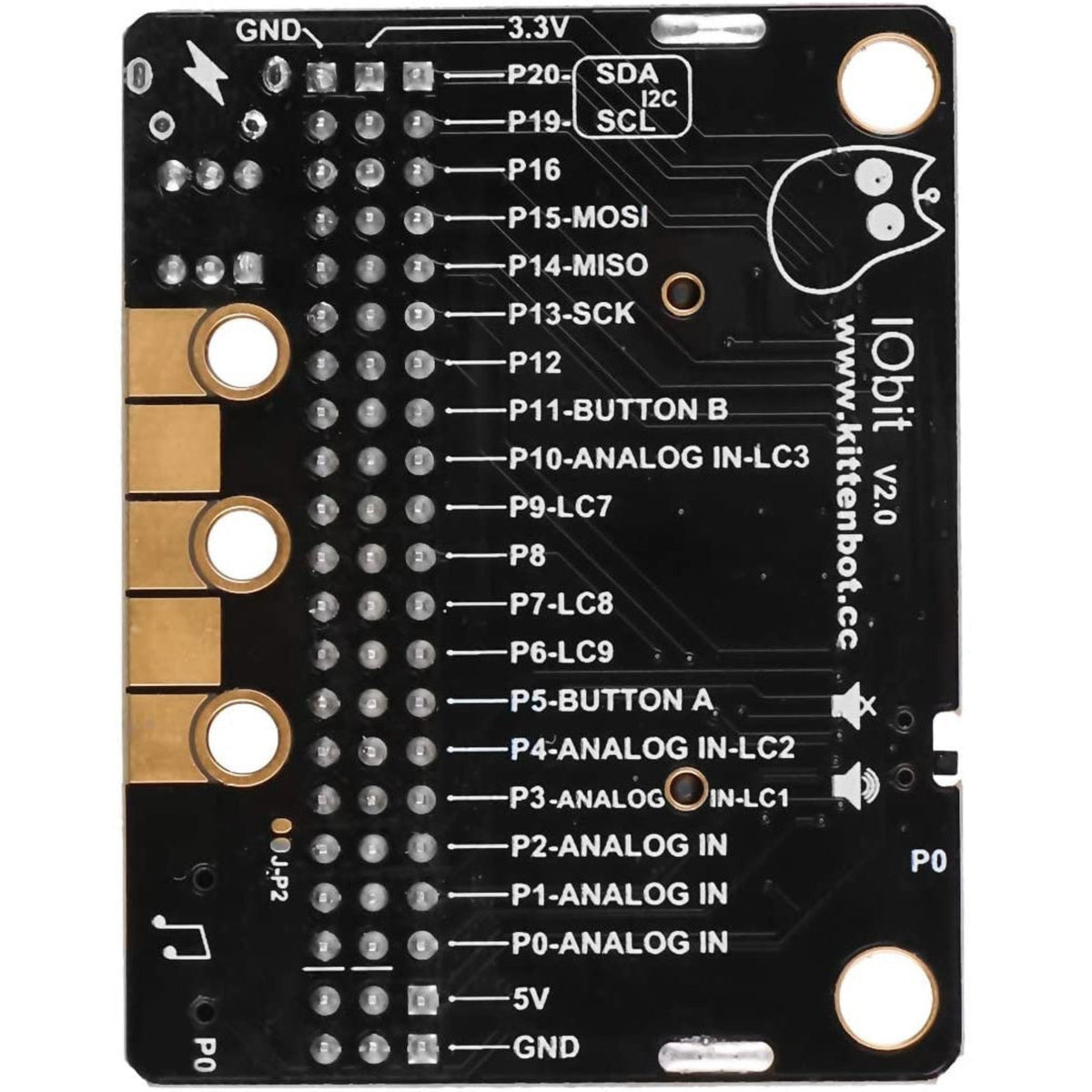
The IOBIT V2.0 is a horizontal expansion board designed to unlock the full potential of your BBC Micro:bit V1 or V2. It breaks out all Micro:bit pins into color-coded 3-pin headers supporting both 3.3V and 5V sensor modules. Featuring a built-in passive buzzer, a 3.5mm audio jack, and LEGO-compatible mounting holes, this breakout shield is the perfect foundation for classroom STEM education, DIY robotics, and Python programming projects.
Key Features
Key Features
- Universal Compatibility: Designed to fit both BBC Micro:bit V1.0 and V2.0 boards perfectly via a horizontal slot.
- Color-Coded 3-Pin Headers: Easily connect 3.3V and 5V sensors using standard jumper wires without a breadboard.
- Integrated Audio Output: Features a built-in passive buzzer and a 3.5mm headphone jack for MakeCode music projects.
- External Power Support: Includes a 5V 1A USB input with a self-recovery fuse to safely power external servos and modules.
- Alligator Clip Friendly: Five large gold fingers allow for quick, solderless connections for beginner experiments.
- LEGO-Compatible Mounting: Four precision-drilled holes allow seamless integration with LEGO building blocks.
Full Product Description
Full Product Description
Complete Pin Access for Versatile Sensor Connections
This horizontal expansion board gives you unrestricted access to all Micro:bit pins, converting them into standard 3-pin (Signal, VCC, GND) headers. The color-coded interface (Yellow for IO, Red for 3.3V/5V, Black for GND) prevents wiring mistakes during complex builds. It also features five dedicated gold fingers (0, 1, 2, 3V, GND) that seamlessly dock with alligator clips, protecting the Micro:bit's original edge connector from wear and tear.
Built-in Audio and LEGO Compatibility
The IOBIT V2.0 integrates a passive buzzer and a 3.5mm audio jack directly onto the board, allowing you to output sound and music without wiring external speakers. A convenient toggle switch lets you instantly mute the buzzer when using pin P0 for other sensors. Additionally, the board includes four LEGO-compatible pin holes, making it incredibly easy to mount your Micro:bit securely onto custom robotic chassis or structural builds.
Technician Tip
When connecting motors or servos, never rely solely on the Micro:bit's power supply, as the IO ports output less than 200mA and will burn out if connected to heavy loads like an MG995 servo. Instead, plug an external 5V power source into the expansion board's USB port (max 1A input) to safely drive multiple small servos. If you are sourcing components for a school robotics project, visit Sun Cheong Computer Co. Ltd. in Sham Shui Po—our staff can help you select the correct low-current modules that pair safely with this board.
Technical Specifications
Technical Specifications
- Compatibility: BBC Micro:bit V1.0 and V2.0
- Mounting Style: Horizontal slot adapter
- Expansion Interface: 3-pin headers (Signal, VCC, GND)
- Power Output Support: 3.3V and 5V sensor modules
- External Power Input: USB 5V (Maximum 1A input with self-recovery fuse)
- Audio Features: 3.5mm audio jack, passive buzzer (with toggle switch)
- Gold Fingers: 0, 1, 2, 3V, GND
- Mounting Holes: 4x LEGO-compatible pin holes
Delivery Options
Delivery Options
- Local delivery within Hong Kong and in-store pickup.
- Free shipping for orders of HK$400 or above; HK$35 shipping fee for orders below HK$400.
- Shipped by SF Express, usually dispatched the same day for orders confirmed before 6:00 PM (Mon–Sat).
- Estimated delivery time: 1–3 business days after dispatch (Hong Kong).
- In-store pickup details (location and time) will be confirmed by email or phone message.
- Delivery times are estimates and may be affected by weather or unforeseen circumstances.
FAQ Section
FAQ Section
Can I drive a large DC motor or an MG995 servo directly from the IO pins?
No, the IO ports on this board have a driving current of less than 200mA. Connecting high-current devices directly will burn out your Micro:bit. You must use a dedicated motor driver module or supply external 5V power via the board's USB port to drive small 9g servos (max 1A total).
Why is the built-in buzzer making a continuous noise when I connect a sensor to pin P0?
Pin P0 is shared with the built-in passive buzzer. If you are using P0 as a normal IO port for a sensor, you must flip the buzzer toggle switch to the "OFF" position, otherwise, the buzzer will sound erratically and your sensor readings will be abnormal.
Can I use pins P19 and P20 for standard sensors and LEDs?
No, pins P19 and P20 cannot be used as standard IO ports on this expansion board. They are strictly reserved for I2C communication. While the MakeCode software might allow you to program them, they will not function correctly with standard sensors in reality.
Why are my Micro:bit's LED matrix lights behaving randomly?
If you are using shared pins (such as 3, 4, 5, 6, 7, 8, 9, 10, or 11) for external sensors, they will conflict with the Micro:bit's built-in LED matrix. You must disable the dot matrix screen within your MakeCode or Python software to use these pins properly.
Do you have this IOBIT V2.0 expansion board in stock in Hong Kong?
Yes, we carry the IOBIT V2.0 Micro:bit expansion board in stock at our Sham Shui Po physical store. You can order online or drop by during business hours to pick it up along with compatible sensors and jumper wires.
Target Users / Applications
Target Users / Applications
- STEM Educators: Providing students with a safe, solderless platform to connect sensors during classroom coding lessons.
- Robotics Beginners: Building smart cars or robotic arms using LEGO blocks and small 9g servos.
- Interactive Art Creators: Using the built-in buzzer and 3.5mm audio jack to program musical instruments or sound-reactive displays.
- Python/MakeCode Learners: Transitioning from basic Micro:bit coding to hardware integration using 3.3V and 5V external modules.