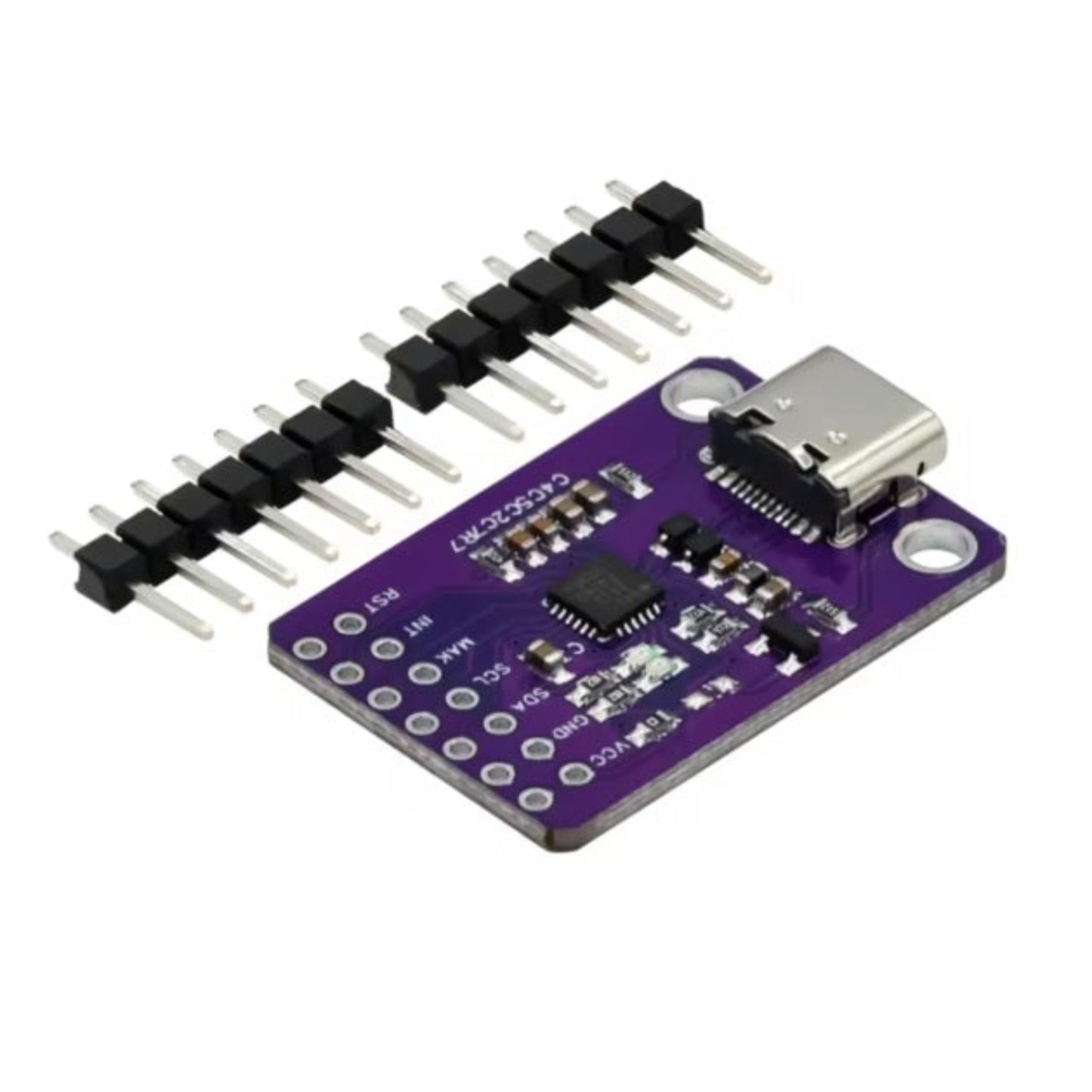


CP2112 USB-C to SMBus/I2C Communication Module | Debugging Board
CP2112 USB-C to SMBus/I2C Communication Module | Debugging Board
Couldn't load pickup availability
Short Product Description
Short Product Description
Streamline your sensor development and firmware debugging with the CP2112 USB to SMBus/I2C Bridge Controller. Featuring a modern USB-C interface, this module connects your PC directly to slave devices without the need for complex firmware. Ideal for rapid prototyping, accessing sensor data (like CCS811), and simplified HID-class USB communication.
Key Features
Key Features
- Modern USB-C Interface: Durable, reversible connector ensures reliable data transfer and power delivery (upgrade from MicroUSB).
- Driverless HID Operation: Uses standard HID drivers, eliminating complex driver installation on Windows/Mac/Linux.
- Integrated SMBus Bridge: Seamlessly converts USB commands to SMBus/I2C master transactions.
- 8 Programmable GPIO Pins: Flexible I/O options for controlling LEDs, reading switches, or generating clock signals.
- Wide Logic Compatibility: Supports I/O voltage from 1.8V to 3.6V, making it compatible with modern low-voltage sensors.
- Industrial Operating Range: Reliable performance from -40°C to +85°C.
Full Product Description
Full Product Description
Effortless USB-to-I2C Bridging for Developers
Stop wasting time writing microcontroller firmware just to test a sensor. The CP2112 USB to SMBus/I2C Communication Module acts as a direct bridge between your computer (Windows, Mac, or Linux) and your target I2C/SMBus devices. Whether you are an engineer debugging a new PCB or a hobbyist reading data from an environmental sensor, this tool provides immediate access via a robust USB Type-C connection.
Plug-and-Play HID Architecture
Unlike older bridges that require messy custom drivers, the CP2112 utilizes the standard USB HID (Human Interface Device) class. This means native support on most operating systems. Simply plug it in, use the available libraries (Silicon Labs API), and start sending I2C commands immediately.
Powerful Connectivity & GPIO Control
This module is built around the highly integrated Silicon Labs CP2112 controller. Beyond simple communication, it offers:
- 8 Configurable GPIOs: Can be set as Input/Output, Open-Drain/Push-Pull, or for special functions like clock output (48MHz to 94kHz).
- No Firmware Required: All customization is handled through a simple GUI-based configurator on your PC.
- Robust Design: Features on-chip voltage regulation and protection, making it safe for your connected devices.
Ideal for Sensor Calibration
Perfect for working with modules like the CCS811 (Air Quality), BME280, or EEPROMs. The board enables you to read registers and calibrate settings directly from your desktop environment before integrating the sensor into your final microcontroller project.
Technical Specifications
Technical Specifications
- Chipset: Silicon Labs CP2112
- Interface: USB Type-C (USB 2.0 Full Speed – 12 Mbps)
- Protocol Support: SMBus / I²C (Master Mode)
- Supply Voltage (USB): 4.0V – 5.25V
- I/O Voltage: 3.0V – 3.6V (VDD Output), tolerant from 1.8V to VDD
- Output Voltage: 3.45V (on-chip regulator)
- GPIOs: 8 pins (configurable as I/O or special function)
- Buffer: 512-byte SMBus data buffer
- Dimensions: Approx. 29.5 mm × 21.3 mm
- Included Accessories: 1× module, 1× pin header strip
Delivery Options
Delivery Options
- Local delivery within Hong Kong and in-store pickup.
- Free shipping for orders of HK$400 or above; HK$35 shipping fee for orders below HK$400.
- Shipped by SF Express, usually dispatched the same day for orders confirmed before 6:00 PM (Mon–Sat).
- Estimated delivery time: 1–3 business days after dispatch (Hong Kong).
- In-store pickup details (location and time) will be confirmed by email or phone message.
- Delivery times are estimates and may be affected by weather or unforeseen circumstances.
FAQ Section
FAQ Section
Q: Do I need to install specific drivers for Windows 10/11?
A: Generally, no. The CP2112 uses the standard HID (Human Interface Device) class, which is built into Windows, Mac, and Linux. However, to interface with it via software, you may need the Silicon Labs HID-to-SMBus libraries or compatible software (like hidapi).
Q: Can this module power my sensor directly?
A: Yes, the module has a voltage regulator output (VCC pin) that typically provides around 3.45V, suitable for powering most standard I2C sensors and low-power peripherals.
Q: Is this the MicroUSB or USB-C version?
A: This is the upgraded version featuring a USB Type-C connector, offering better durability and cable compatibility than the older MicroUSB models.
Target Users / Applications
Target Users / Applications
- Embedded Systems Engineers: For rapid sensor debugging and register configuration.
- IoT Developers: Testing I2C peripherals (Temperature, Humidity, Gas sensors) before coding MCU firmware.
- Repair Technicians: Reading/Writing EEPROM data on logic boards.
- STEM Education: Teaching serial communication protocols without the complexity of writing driver code.