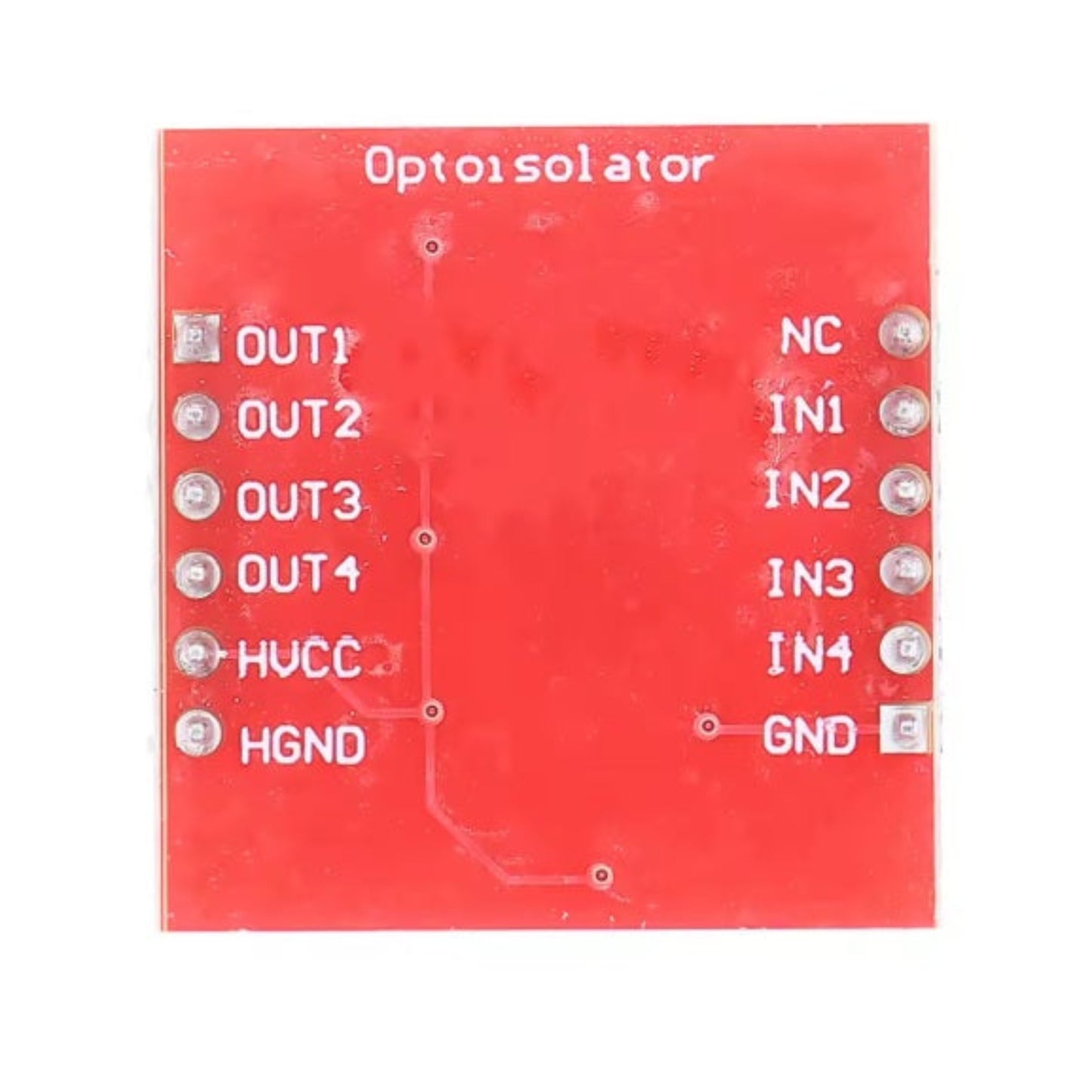


TLP281 4-Channel Opto-isolator Module | Signal Isolation for Arduino
TLP281 4-Channel Opto-isolator Module | Signal Isolation for Arduino
Couldn't load pickup availability
Short Product Description
Short Product Description
Protect your microcontrollers from noise and high-voltage spikes. This 4-channel opto-isolator creates a safe electrical barrier between your sensitive logic (Arduino/STM32) and high-power devices like motors and servos. Features built-in logic correction for seamless non-inverting control. Ideal for noise suppression in DIY electronics and industrial prototypes.
Key Features
Key Features
- Electrical Isolation Barrier: Completely separates low-voltage logic (MCU) from high-voltage loads, preventing damage from surges.
- Smart Logic Correction: Features discrete transistors to ensure non-inverting output (Input High = Output High), saving you coding time.
- 4-Channel Control: Independent control for up to 4 distinct signal lines simultaneously.
- Wide Voltage Compatibility: Supports HVCC (High Voltage side) up to 24V, making it versatile for PLC and solenoid control.
- MCU Friendly: Optimized for standard 3V and 5V logic levels (Arduino, PIC, AVR, ARM, Raspberry Pi).
Full Product Description
Full Product Description
Secure Your Signals: The Ultimate Noise Barrier for Microcontrollers
Building a robotics project or an industrial control system? Connecting 3.3V or 5V logic microcontrollers (like Arduino, ESP32, or Raspberry Pi) directly to high-voltage components carries a risk. Motor noise, voltage spikes, and electromagnetic interference (EMI) can crash your processor or permanently damage your board.
The TLP281 4-Channel Opto-isolator Module is your safety net. It uses light signals—rather than direct electrical connections—to transfer data between two isolated circuits. This effectively "air-gaps" your sensitive processor from the noisy, high-voltage side (up to 24V).
Logic Correction Built-In
Standard opto-isolators often invert your signal (High becomes Low), forcing you to rewrite your code. This module solves that pain point. It includes discrete transistors to automatically correct the logic inversion. If you send a HIGH signal to the input, you get a HIGH signal at the output—just at a higher voltage capability.
Why You Need This Module:
- Voltage Level Shifting: Safely control 12V or 24V devices using a 3.3V or 5V microcontroller.
- Noise Elimination: Perfect for preventing motor interference from resetting your Arduino.
- Simple Integration: Compact design fits easily into custom PCBs or breadboard prototypes.
Technical Specifications
Technical Specifications
- Model: TLP281 4-Channel Opto-isolator Module
- Input Voltage (Logic): DC 3V – 5V (Compatible with Arduino/STM32)
- Output Voltage (HVCC): Max 24V DC
- Channels: 4 independent channels
- Output Type: Non-inverting (logic corrected)
- Output Current: HVCC / 5.1K (pull-up limited)
- Max Sink Current: 500mA (peak absorption)
- PCB Dimensions: 25mm × 24mm
- Mounting: Standard 2.54mm pitch headers
Delivery Options
Delivery Options
- Local delivery within Hong Kong and in-store pickup.
- Free shipping for orders of HK$400 or above; HK$35 shipping fee for orders below HK$400.
- Shipped by SF Express, usually dispatched the same day for orders confirmed before 6:00 PM (Mon–Sat).
- Estimated delivery time: 1–3 business days after dispatch (Hong Kong).
- In-store pickup details (location and time) will be confirmed by email or phone message.
- Delivery times are estimates and may be affected by weather or unforeseen circumstances.
FAQ Section
FAQ Section
Q: Does this module invert the signal logic?
A: No. Unlike bare optocoupler chips, this breakout board includes extra transistors to correct the logic. A High input results in a High output, making it much easier to program.
Q: Can I use this to drive a motor directly?
A: No, this is designed for signal isolation and low-current switching. While it can handle small loads, it is best used to send clean signals to a high-power driver (like a MOSFET or Relay module) that controls the motor.
Q: What is the maximum voltage for the high-voltage side?
A: The HVCC pin supports a maximum of 24V DC. This makes it suitable for standard 12V and 24V industrial or automotive control signals.
Target Users / Applications
Target Users / Applications
- IoT Developers: Interfacing 3.3V ESP8266/ESP32 sensors with 5V or 12V systems.
- Robotics Engineers: Isolating motor driver signals to prevent MCU resets.
- Industrial Automation: PLC signal interfacing and noise suppression.
- Makers & Students: Arduino projects involving solenoids, relays, or high-noise components.