

0.42" Ultra-Micro OLED Display Module (White Light) | I2C, SSD1306
0.42" Ultra-Micro OLED Display Module (White Light) | I2C, SSD1306
Couldn't load pickup availability
Short Product Description
Short Product Description
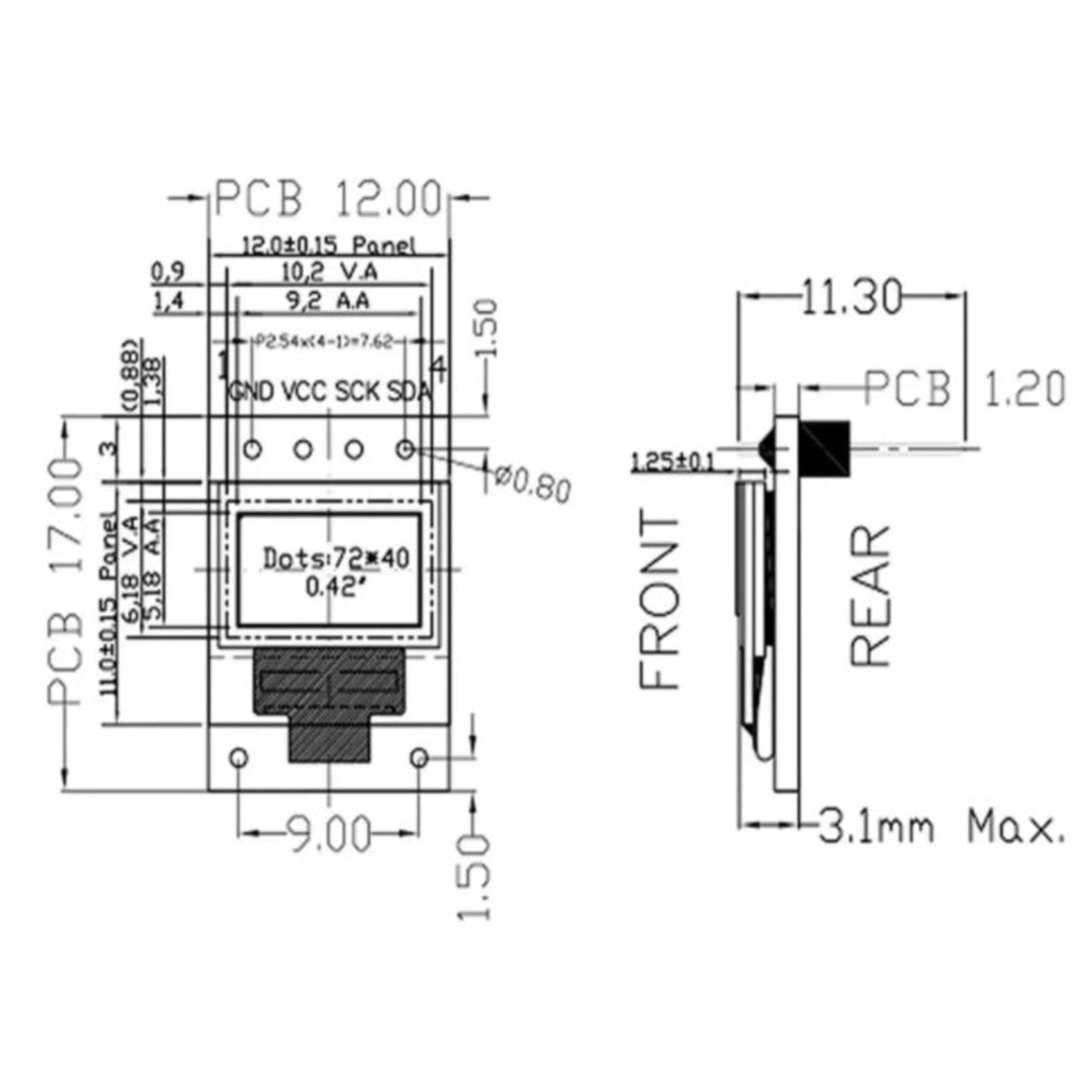
Space is no longer a limit for your electronics. This 0.42-inch ultra-micro OLED display delivers crisp, high-contrast white light graphics in an incredibly compact 12x17mm footprint. Powered by the reliable SSD1306 controller and utilizing a simple 4-pin I2C interface, it is the perfect visual upgrade for wearables, compact IoT sensors, and advanced STEM micro-projects.
Key Features
Key Features
- Ultra-Compact Form Factor: Measures just 12x17mm, perfect for integrating into space-constrained wearable or micro-robotics housings.
- Self-Illuminating OLED Tech: Eliminates the need for a bulky backlight, reducing power consumption while delivering deep blacks and vibrant white light.
- I2C Communication Protocol: Uses only 4 pins (VCC, GND, SDA, SCK), saving critical microcontroller IO pins for other vital components.
- Broad Compatibility: Driven by the ubiquitous SSD1306 chip, ensuring instant compatibility with popular open-source libraries like U8g2 and Adafruit GFX.
- Wide Operating Temperature: Functions reliably from -40°C to 70°C, making it suitable for demanding industrial or outdoor STEM applications.
Full Product Description
Full Product Description
Break the Size Barrier in DIY Electronics
When designing compact IoT devices or wearable tech, finding a screen that fits without sacrificing readability is a major challenge. The 0.42-inch PM OLED display module solves this by offering a bright, self-illuminating visual interface on a board smaller than a postage stamp.
Crisp White Light Readability
Unlike traditional LCDs, this OLED technology requires no backlight. Every pixel emits its own pure white light, resulting in infinite contrast and exceptional clarity, even in fully lit environments. Whether you are displaying temperature readings, battery levels, or micro-animations, the 72x40 resolution ensures your data is razor-sharp.
Seamless Microcontroller Integration
Powered by the industry-standard SSD1306 control chip, integrating this screen into your existing architecture is effortless. It communicates via an I2C interface, meaning you only need two data pins (SDA and SCK) to bring your screen to life. This frees up valuable GPIO pins on your Arduino, Raspberry Pi, or ESP32 development boards for other sensors and motors.
Technical Specifications
Technical Specifications
- Screen size: 0.42 inch diagonal
- Panel type: PM‑OLED (Passive‑Matrix OLED)
- Resolution: 72 × 40 dots
- Interface: IIC / I²C (4‑pin)
- Operating voltage: 3.3 V
- Controller chip: SSD1306
- Display color: Monochrome white
- Active area: 9.196 × 5.18 mm
- Module dimensions: 12 × 17 mm
- Pixel pitch: 0.128 × 0.13 mm
- Pixel size: 0.108 × 0.11 mm
- Viewing angle: Full / wide viewing angle (all directions)
- Operating temperature range: −40 °C to +70 °C
Delivery Options
Delivery Options
- Local delivery within Hong Kong and in-store pickup.
- Free shipping for orders of HK$400 or above; HK$35 shipping fee for orders below HK$400.
- Shipped by SF Express, usually dispatched the same day for orders confirmed before 6:00 PM (Mon–Sat).
- Estimated delivery time: 1–3 business days after dispatch (Hong Kong).
- In-store pickup details (location and time) will be confirmed by email or phone message.
- Delivery times are estimates and may be affected by weather or unforeseen circumstances.
FAQ Section
FAQ Section
Q. What microcontrollers are compatible with this display?
A. It operates on 3.3V logic and uses I2C, making it fully compatible with ESP32, Raspberry Pi Pico, and 3.3V Arduino variants. For 5V boards like the Arduino Uno, a logic level converter is recommended for optimal lifespan.
Q. Which library should I use to program the SSD1306 chip?
A. We highly recommend the U8g2 library for text-heavy applications or the Adafruit_SSD1306 library for general graphics. Both are fully supported in the Arduino IDE.
Q. Does this screen require a separate backlight power supply?
A. No. OLED (Organic Light Emitting Diode) pixels generate their own light. This makes the module significantly thinner and more power-efficient than standard LCDs.
Target Users / Applications
Target Users / Applications
- Makers & DIY Enthusiasts: Building custom smartwatches, mini weather stations, or pocket-sized gaming devices.
- STEM Educators & Students: Learning I2C communication and display programming on Arduino/Raspberry Pi platforms.
- Hardware Engineers: Prototyping compact industrial sensors, digital panel meters, and diagnostic tools.